P.A.I.R. · Manual · First edition · 2026
Accessibility Is the Aesthetic
The Creative Accessibility Methodology Manual. A practical framework for research, co-creation and inclusive cultural production
Developed within P.A.I.R. | Paving Accessible Inclusive Realities
Publication information
Accessibility Is the Aesthetic: The Creative Accessibility Methodology Manual.
First edition
© P.A.I.R. Consortium, 2026
This publication was developed as part of Paving Accessible Inclusive Realities (P.A.I.R.), a Creative Europe project led by liminal in Greece, with Alternative Brains Rule in Cyprus and the Estonian Agrenska Foundation in Estonia. It brings together learning from the project’s research and mapping, capacity building, collaborative co-creation and production, and shared reflection to support applying the Creative Accessibility Methodology (C.A.M.).
This publication is licensed under the Creative Commons Attribution–NonCommercial 4.0 International licence (CC BY-NC 4.0).
You are free to share and adapt its content for non-commercial purposes, provided appropriate credit is given to the P.A.I.R. project, a link to the licence is included, and any changes are indicated.
Full licence here: [https://creativecommons.org/licenses/by-nc/4.0/](https://creativecommons.org/licenses/by-nc/4.0/]
Suggested citation:
Accessibility Is the Aesthetic: The Creative Accessibility Methodology Manual. P.A.I.R. Project, 2026.
Partners and logos


Co-funded by the European Union.
The project is implemented with financial support and under the auspices of the Greek Ministry of Culture.
Views and opinions expressed are those of the authors only and do not necessarily reflect those of the European Union or the European Education and Culture Executive Agency (EACEA). Neither the European Union nor EACEA can be held responsible.
Credits
Curation and editorial coordination
Marilena Koukouli and Christos Papamichael (liminal)
Editorial review, proofreading and bibliographic consultation
Thomas Diafas
Digital publication and PDF design
Martha Georgiou
Web presentation and implementation
Olympia Antonena, Larry Ioannidis
Contributions
This manual draws on the collective knowledge, lived experiences, expertise and reflections of the P.A.I.R. partner organisations, Collaborative Working Groups and participating artists.
Partner contributors
Martha Georgiou and Constantinos Kyprianou (Alternative Brains Rule)
Meelis Joost and Mari Tuulik (Estonian Agrenska Foundation)
Contributing artists
Nafsika Hadjichristou
Open P.Arts Collective (Sara Fontana, Marleen Kuusik and Heleri Luuga)
Lykourgos Porfyris
External contributor Thomas Diafas
Collaborative Working Groups
Estonia
Daniel Kotsjuba, Mare Kõrtsini and Hendra Raud
Cyprus
Demetra Nikodemou, Roz, Eve Petrakidou, Marina Ierides, Nina Poulouzasvili, Melina Theodorou, Martha Georgiou and Constantinos Kyprianou
Greece
Nikos Voyiatzis, Eva Gkritzali, Thomas Diafas, Andreas Plemmenos, Maria Thrasyvoulidi and Grigoris Stathopoulos
Acknowledgements
We warmly thank everyone who participated in the workshops, surveys, focus groups and brainstorming sessions throughout the P.A.I.R. project. Their experiences, perspectives, ideas and feedback enriched the collaborative process and contributed to the development of the Creative Accessibility Methodology.
AI use disclaimer
AI-assisted tools supported drafting, editing, and refining this manual. The editorial team reviewed and revised all content and retains responsibility for its accuracy, interpretation, and final presentation.
How to use this manual
This manual is for artists, producers, educators, access professionals and cultural organisations. You can read it from beginning to end or use it when a project needs support.
- Part 1 sets out the proposition behind Creative Accessibility.
- Part 2 gives the essential foundations and a compact access overview.
- Part 3 introduces the five phases of the Creative Accessibility Methodology (C.A.M.).
- Part 4 shows how the methodology was tested through three P.A.I.R. artworks.
- Part 5 draws eight transferable lessons from the artworks and shows how to use them.
- Part 6 turns the learning into reusable tools.
This manual offers practical guidance; it does not provide certification or guarantee universal access. Adapt its tools to your context, involve the people affected by decisions, pay contributors for their expertise, test ideas in practice, and clearly communicate access arrangements and limitations.
Companion zine
For a quick, printable, accessible guide for artists, producers and cultural teams, see the companion zine: “Accessibility Is the Aesthetic: A ZINE for Creative Accessibility”. [link to be added] It distills this methodology into a short, shareable publication.
About P.A.I.R.
P.A.I.R. - Paving Accessible Inclusive Realities is a Creative Europe project led by liminal in Greece, in collaboration with Alternative Brains Rule in Cyprus and the Estonian Agrenska Foundation in Estonia. The project seeks to redefine access and participation in culture by placing equality, equity and inclusion at the centre of artistic processes and decisions.
P.A.I.R. supports mutually beneficial collaboration between cultural organisations, disability communities, artists, creative professionals and accessibility experts. At the heart of the project is the Creative Accessibility Methodology (C.A.M.), a participatory framework that helps teams embed accessibility from the earliest stages of creation.
Through research, mapping, capacity-building, collaborative working groups, digital artworks, and inclusive multisensory cultural experiences, P.A.I.R. explores how access can drive artistic innovation, audience development, and sustainability.
The project brought cultural organisations, disability communities, artists, creative professionals and accessibility experts into sustained collaboration. Its work moved through four connected activities:
- Research and mapping: understanding local contexts, relationships, barriers and opportunities.
- Capacity building: training in cultural participation, accessibility, digital accessibility, digital art and Creative Accessibility.
- Co-creation and production: Collaborative Working Groups and artistic teams developing multisensory cultural experiences.
- Reflection and sharing: evaluating the process and translating learning into the C.A.M. and this manual.
Project website: pair.liminal.eu
Foreword
P.A.I.R. grew from an observation shaped by more than a decade of our work: cultural organisations, disability organisations, accessibility professionals and communities often share a genuine desire to come closer, yet face difficulties in understanding one another’s language, expectations and ways of working. These difficulties can create misunderstanding and frustration, sometimes discouraging the very efforts intended to remove barriers to cultural participation.
Through P.A.I.R., we had the opportunity to test and refine a methodology for noticing who is missing, building relationships with people whose perspectives are too often absent from artistic decision-making, and inviting them to shape how art is imagined and created.
The process confirmed our belief that every contribution matters if we want to reshape the cultural ecosystem so that it can make room for us all. We hope this manual inspires others to develop their own creative frameworks for a future in which participation is non-negotiable and firmly embedded in cultural practice.
Christos Papamichael
Founder, Director, liminal
Partner reflections
P.A.I.R. gave us a valuable opportunity to work with artists and other working group members, bringing different perspectives together to develop practical accessibility solutions. Our contribution focused particularly on accessible information and communication, complementing the artists’ existing knowledge of physical accessibility. A key takeaway was the value of developing a shared plan: deciding what to do, in which order, and how much time each stage requires. Participating gave us a clearer understanding of how to organise accessibility work within a creative process, providing practical insights for future collaborations.
“Missing Frequencies marked the first time we developed an artwork with this range of creative accessibility practices embedded from the very first conversations. Working with the Collaborative Working Group, bringing disabled artists, access practitioners and creative professionals around one table, shifted accessibility from a matter of compliance into part of the artistic practice itself.
The haptic cushions, continuous audio description, bilingual captioning, Cypriot Sign Language hosting and layered seating were not added at the end. They became part of the material the artist composed with. What we take forward is a clearer understanding that a work becomes more accessible as the number of ways into it increases, and that this is also what makes it artistically richer.”
Part 1
Why Creative Accessibility?
From accommodation to co-creation.
From compliance to experimentation.
From separate services to shared artistic language.
Accessibility often enters a project late: captions are commissioned after editing, audio description after a premiere, or a route is reconsidered when a barrier has already excluded someone. These measures may be necessary, but late access has little opportunity to influence the artwork itself.
Creative Accessibility starts earlier. It asks:
What happens when accessibility is part of the first conversation, the first sketch and the first artistic decision?
This question changes both process and form. Language, movement, sound, space, technology, time and participation become access decisions and artistic decisions at once. Captions may shape rhythm and visual composition. Audio description may become narration or poetry. Sign language may influence performance and choreography. Tactile, spatial or sensory choices may alter dramaturgy and audience relationships.
Creative Accessibility also transforms who is recognised as a holder and producer of knowledge. Disabled and D/deaf artists, audiences, and access professionals are not simply recipients of access provision, nor should their roles be reduced to delivering access. Their lived, artistic, and technical expertise can challenge underlying assumptions, reframe the questions being asked, and generate new forms, practices, and possibilities that might not otherwise emerge.
This reciprocal understanding of access is expressed in a reflection quoted in Fotiadi (2025, p. 50):
“I think too often there is an understanding that the cultural institutions bestows access, and then the people who have received the access then go away. What I’m advocating for is a more two-sided interaction. And that when you give blind people access, they have something to bring to the table in terms of a different perspective.”
Creative Accessibility makes space for this exchange from the outset, allowing different perspectives to shape both the artistic process and the work itself.
The aim is not to make access decorative. An access element must still perform its essential function: captions must be readable, description must communicate relevant information, interpretation must be linguistically sound, and tactile engagement must be safe and meaningful. Creative expression and usability are developed together through collaboration and testing.
Ultimately, Creative Accessibility is built on a simple conviction: accessibility is not an obstacle to artistic practice; it is one of the conditions that makes new artistic possibilities possible.
The shift can be summarised as
Access needs/Accessibility tools → shared research → artistic language → new form/aesthetics → wider participation → New cultural imaginaries
The Creative Accessibility Methodology (C.A.M.) supports this shift. It is a flexible, cyclical framework rather than a fixed recipe. Teams can enter it at different points, revisit decisions and adapt the process to the art form, community and resources.
Part 2
Foundations
2.1 Culture is a right and a relationship
Article 27 of the Universal Declaration of Human Rights recognises the right to participate freely in cultural life and enjoy the arts. Article 30 of the UN Convention on the Rights of Persons with Disabilities reinforces this right for disabled people.
Participation means more than entering a venue or consuming a finished work. It includes creating, deciding, learning, expressing identity, sharing knowledge, responding, and belonging. Every decision about a venue, schedule, budget, language, technology, sensory environment, or artistic form affects who can take part and on what terms.
For the cultural sector, broader participation can strengthen community relationships, audience development and long-term relevance.
Who currently creates and makes decisions in your work? Who attends but has little influence? Who is absent, and what in the current process may be keeping them out?
2.2 How disability is understood shapes practice
How we understand disability shapes how we approach accessibility. Medical and charity approaches have often located disability within the individual. Social and human rights approaches shift attention towards barriers, equality and participation, while affirmative perspectives recognise the cultural and creative value of disabled experience.
The five models below offer different ways of understanding disability and its implications for cultural practice. They can overlap and coexist within the same institution or project. P.A.I.R. draws primarily on social, human rights and affirmative perspectives; the medical and charity models are included to make visible assumptions the methodology seeks to move beyond.
Scroll the table sideways to see every column.
| Model | Main focus | Likely effect on cultural practice |
|---|---|---|
| Medical | Disability understood primarily as an individual condition requiring treatment or rehabilitation | Access tends to focus on individual adjustments rather than changes to cultural structures. |
| Charity | Disabled people’s needs and others’ benevolent response | Access may be offered as a favour, with disabled people positioned as recipients rather than makers or decision-makers. |
| Social | Disability produced by social organisation and barriers that exclude people with impairments | Attention shifts towards removing barriers and changing spaces, systems and processes, with disabled people shaping those changes. |
| Human rights | Equality, dignity, autonomy and participation | Access becomes a matter of rights, institutional responsibility and accountability. |
| Affirmative / cultural | Disability as a source of identity, knowledge, community and creative perspective | Disabled experience and disability culture can shape aesthetics, methods and meaning. |
Impairment and disability. Impairment refers here to differences or alterations in bodily or mental functioning. Disability concerns the restrictions on participation that arise through interaction with environmental, social and attitudinal barriers. The UN Convention on the Rights of Persons with Disabilities emphasises this interaction and recognises physical, mental, intellectual and sensory impairments (United Nations, 2006, preamble, para. e; Article 1).
The Creative Accessibility Methodology is grounded primarily in the social model of disability. It asks: “What barriers exist, and how can they be transformed?” This directs attention towards environments, artistic processes and cultural systems, making accessibility part of how a project is conceived and developed.
The methodology also draws on a human rights perspective, which understands equality, dignity and participation as rights. Access to cultural and artistic life is therefore an institutional responsibility. This includes opportunities for disabled people to develop and share their creative work, as well as to participate as audiences (United Nations, 2006, Article 30).
The affirmative model recognises disabled identities and experiences as sources of value, knowledge and belonging. In cultural practice, this opens questions about how disability culture and lived experience can shape language, form, rhythm, perspective and meaning. This recognition does not require every disabled person to experience disability positively or to make it the subject of their work.
These perspectives inform three connected questions at the centre of C.A.M.:
- What barriers are produced by the environment or process?
- What must change to support equitable participation, choice and control?
- How can disability culture and lived experience shape the work?
These questions connect the foundations of C.A.M. to the Aesthetics of Access approach explored later in this manual: access is both a right to be upheld and a creative resource that can shape artistic practice. See 2.7
2.3 Universal Design is a starting point
Universal Design seeks environments, services and experiences usable by the widest possible range of people from the outset. Its principles emphasise equitable use, flexibility, simplicity, perceptible information, tolerance for error, low physical effort and adequate space.
Universal Design can remove many predictable barriers, but it cannot guarantee that one solution will work for everyone. Access requirements may differ or conflict. Individual adjustments, specialist services and dialogue remain necessary. Treat “universal” as a direction of travel, not a claim of completion.
Explore the seven principles of Universal Design → Centre for Excellence in Universal Design
2.4 A compact access overview
Access requirements overlap and vary between people. The table below is a starting point, not a prescription. Ask people what they need, work with relevant professionals and test with intended users.
Before beginning a Creative Accessibility process, creative teams should develop a clear understanding of the range of accessibility services, approaches and tools available, as well as their appropriate use and limitations. Where specialised knowledge or expertise is required, teams should collaborate with qualified accessibility professionals and disabled people with relevant lived experience.
The aim is not to offer every possible service in every project. It is to understand the people and context, identify priorities, plan responsibly, and communicate clearly and honestly about what is available. Approach accessibility as an ongoing process of consultation, collaboration, testing, and refinement rather than a checklist of services.
Scroll the table sideways to see every column.
| Access area | Services, approaches and tools | Questions |
|---|---|---|
| Physical and spatial | Step-free routes; lifts; unobstructed circulation; varied seating; accessible toilets; rest areas; backstage access; inclusive evacuation | Can artists, workers and audiences complete the whole journey safely and with choice? Have routes and facilities been checked in person? |
| Language and communication | Relevant sign languages; captions; transcripts; multilingual information; communication support | Are interpreters or captioners involved early? Are they visible, well placed and given scripts and schedules? |
| Visual information | Audio description; touch tours; tactile models; Braille; large print; accessible digital text; audio versions | What visual information is essential, and which format communicates it most effectively? |
| Cognitive and information | Plain language; Easy Read; predictable structure; advance information; visual schedules; pictograms | Is essential information easy to find and understand? Are people given enough time and more than one way to process instructions? |
| Sensory | Advance information; quiet space; flexible seating; relaxed conditions; reduced-stimulation events; breaks; adjustable intensity; permission to move, leave and return | Can people anticipate the sensory environment and choose their level, duration or route of engagement? |
| Digital | Keyboard and screen-reader access; alt text; captions and transcripts; clear headings; sufficient contrast; accessible documents | Can people perceive, operate and understand the digital experience with different devices and assistive technologies? |
| Social and economic | Welcoming staff; clear procedures; affordable participation; paid expertise; personal assistance; childcare; travel support | Are cost, confidence, discrimination or organisational culture creating barriers even when technical access exists? |
Further reading → Access Toolkit for Art Workers
Practical guidance for embedding accessibility in artistic planning, production, workplaces and audience experiences.
Access riders
An access rider lets an artist, worker or participant describe the conditions and support they need to take part safely and equitably. It may cover physical and digital access, communication, travel, working hours, breaks, medication, sensory needs, personal assistance, interpretation and emergency arrangements.
Access riders reduce the burden on disabled, Deaf, neurodivergent and chronically ill people of repeatedly explaining or defending their needs, while supporting clear and respectful communication between everyone involved.
Ask for access riders early, budget for what they identify, and revisit them when the context changes. Treat them as confidential, person-led planning tools, not as requests that people must repeatedly justify.
Practical guidance → Access riders — Disability Arts Online
Rider vs. Statement
An access rider is written by an artist for themselves. The organisation writes an Access Statement (see Tool 6) for the audience. They are different documents with different purposes — do not conflate them.
2.5 Digital accessibility and digital equity
Digital participation has become an essential part of cultural life. Websites, online events, digital artworks, booking systems and educational resources all influence who can access and contribute to culture.
Digital accessibility means designing digital environments that people with diverse bodies, senses, technologies, and ways of interacting can use. The Web Content Accessibility Guidelines (WCAG 2.2) provide an internationally recognised framework built around four principles: digital content should be Perceivable, Operable, Understandable and Robust.
Digital equity is the condition in which people, regardless of disability, gender, race, socioeconomic position, or other intersecting circumstances, have meaningful opportunities to participate in and benefit from digital environments. It goes beyond access to devices, connectivity, or digital skills to consider how social and digital environments are shaped, sustained, and experienced collectively. Digital equity therefore involves addressing structural inequalities and creating digital conditions that are responsive to diverse lived experiences, support participation and agency, and enable all people to thrive.
Technical compliance alone does not produce digital participation. People also need devices, connectivity, digital literacy, assistive technology, and confidence. Follow the Web Content Accessibility Guidelines where relevant, but also test actual tasks with users and provide another way to obtain essential information or participate.
Further reading
2.6 Time, pacing and crip time
Time is also an access condition, and it is the one least often planned for. Start times, running times, deadlines, queues, the pace of a performance, the length of a form, the notice given before an event and the duration of a funding cycle all decide who can take part. A work can be step-free, captioned, described and affordable and still exclude anyone who cannot arrive at seven, stand for ninety minutes or answer within a week.
Disability studies describes this as crip time. Alison Kafer argues that queer time and crip time have been the same thing all along, and that “these shifts in timing and pacing can of necessity and by design lead to departures from ‘straight’ time” - time organised as a firm line from past to present to future, and as a linear development from dependent childhood to independent adulthood (2013, p. 34). Crip time is not simply slower. It is time that does not assume one average body or one standard pace.
For a cultural project, this is practical, not metaphorical. Time shapes the schedule as much as the artwork: how long a performance runs and whether there is a break; whether latecomers can enter; whether a workshop is recorded; whether a deadline is a date or a conversation; whether a residency assumes uninterrupted weeks. It also shapes the project’s own working rhythm. The pace of collaboration, the timing and duration of meetings, and the space allowed for preparation and response all influence who can contribute and how.
Two cautions. Flexible timing is not the same as vague timing: a project that says “whenever you can” shifts the burden back onto the person and gives them nothing to plan with. And crip time is not a concession granted to a few participants. It describes how everyone’s time already works, which is why it belongs in the project’s design rather than as an adjustment made for one person. Where a deadline is genuinely fixed, say so early, and say what support is available around it.
2.7 The aesthetics of access
Aesthetics of Access is a way of thinking about access not as a service added after a work is finished, but as a creative force within the work itself. The term is closely associated with Graeae Theatre Company, which brings functional access such as captioning, sign language, and audio description to the centre of performance. This shifts the guiding question. Instead of asking how an existing work can be made available to more people, it asks how access shapes what the work becomes: its timing, language, use of space and ways of carrying meaning.
Other artists and organisations develop related approaches. In Finland, DuvTeatern’s TIKSI project treats creative accessibility as an artistic strategy that informs both performance and production, bringing together sign language, creative audio description, easy language and accessible collaboration. Un-Label applies aesthetics of access across dance, theatre, installations and participatory and immersive formats. These examples share a commitment to letting access inform both artistic choices and ways of working.
Caro Verbeek notes that blind and low-vision visitors can help sighted audiences recognise that “art does not represent mere visual affairs, but rather an amalgam of impressions”. Smell, sound, touch, movement and images can come together within a shared encounter, “rather than divided through separate tours” (Fotiadi, ed., 2025, p. 46).
The approach draws on disability arts and disability aesthetics, which treat disability, Deaf culture and neurodivergence as sources of artistic knowledge rather than as problems to solve or subjects to represent. Different ways of perceiving, moving and communicating challenge established ideas about beauty, virtuosity, authorship and the ideal body.
Access, in this sense, is not a limit on creativity. It is one of its materials.
Part 3
The Creative Accessibility Methodology (C.A.M.)
The framework at a glance
The Creative Accessibility Methodology (C.A.M.) is an iterative framework that integrates artistic research, accessibility, collaboration, and reflective practice into a single creative process. C.A.M. positions accessibility as a generative force that informs how ideas are conceived, explored, produced, and experienced.
Its five phases are connected and cyclical: a prototype may reveal a missing relationship; audience feedback may require new context research; a production constraint may send a team back to experimentation.
The C.A.M. cycle
- Context research
- Relationship building
- Co-creation & experimentation
- Production & presentation
- Reflection & iteration
Five phases arranged in a circle and connected by arrows in order: 1 Context research, 2 Relationship building, 3 Co-creation and experimentation, 4 Production and presentation, 5 Reflection and iteration, then back to 1. Dashed arrows show a team looping back: from 3 to 2 when a prototype reveals a missing relationship, and from 4 to 3 when a production constraint sends the team back to experimentation. After 5 the cycle returns to 1.
Scroll the table sideways to see every column.
| Phase | Approach | Guiding question |
|---|---|---|
| 1. Context research | Understand before designing | Whose context and knowledge must shape the project? |
| 2. Relationship building | Build with people, not for people | Who has influence, authority and responsibility? |
| 3. Co-creation and experimentation | Let access shape the work | Which access possibilities should be explored? |
| 4. Production and presentation | Design the whole encounter | What must work across the artwork and audience journey? |
| 5. Reflection and iteration | Learn and carry learning forward | What will be kept, changed, tested and communicated? |
Phase 1 | Context research
Understand before designing.
Purpose: Understand the people, place, barriers, assets, and relationships around the project before fixing the artistic or production response.
Every project begins with listening. Before developing artistic ideas, creative teams take time to understand the people, place, and context in which the work will exist. This means exploring existing relationships, barriers, opportunities and local knowledge, while recognising that no community is the same.
The aim is not simply to identify access needs, but to build an informed foundation for creative decisions.
Ask
- Who is already involved, and who is missing?
Identify who currently participates in your project or organisation and consider whose voices, experiences or perspectives are absent. This helps broaden participation from the earliest stages. - Which physical, sensory, digital, communication, economic or social conditions affect participation?
Explore the physical, sensory, digital, communication, financial and social factors that may either enable or limit participation. At the same time, recognise existing strengths and resources that can support accessibility. - What local knowledge, disabled-led practice and existing resources can the project build on?
Consider who can contribute valuable knowledge through lived experience, artistic practice, or professional expertise. Involving people early creates stronger collaborations and more meaningful outcomes.
Do
- Map the ecosystem. Place the project at the centre and add artists, audiences, disabled-led groups, disability-focused organisations, access professionals, informal networks, institutions, funders and technical partners. Draw current relationships, not aspirational ones: Mark weak links, missing groups and concentrations of power.
- Hold community conversations. Invite the people whose experience can test the map and change the project. Explain the purpose, what is open to influence, how contributions will be used, and what payment and access support are available.
- Turn listening into decisions. Record themes rather than unnecessary personal data. Ask what needs to change in the concept, team, venue, schedule, budget, communication, or access plan.
- Close the loop. Tell contributors what changed, what did not, and why. Update the map and identify who should remain involved.
Safeguards
- Pay for time, preparation, and expertise, including access-related costs.
- Ask about access before meetings and offer different ways to contribute.
- Obtain informed consent for recording, attribution and use of personal experience.
- Do not treat one person as representative of an entire disability community.
- Avoid extractive consultation: maintain appropriate relationships after gathering input.
Output
A short context brief that states the artistic question and records the communities involved, existing assets, barriers to participation, gaps in knowledge, potential collaborators, and decisions still open
P.A.I.R. in practice
P.A.I.R.’s initial research combined three surveys, structured interviews, focus groups, good-practice research and co-design roundtables in Greece, Cyprus and Estonia. The surveys gathered 125 responses across disabled and Deaf people, artists and creative professionals, and organisations. Partners also conducted 13 interviews; four focus groups involved 41 participants; and three national co-design roundtables involved 23 participants. The value of this work was not the numbers alone. It linked evidence to training, local relationships and decisions about what the artistic phase needed to explore.
Phase 2 | Relationship building
Build with people, not for people.
Purpose: Build relationships through which disabled people, artists, access professionals and cultural teams can shape the project over time.
Creative Accessibility begins with relationships. This phase focuses on building trust, establishing shared ways of working and bringing together different forms of lived, artistic, local and technical expertise. Collaboration is understood as an ongoing dialogue rather than a one-off consultation.
The aim is to create the conditions for artistic ideas and accessibility to develop together through mutual respect, shared responsibility and meaningful participation.
Ask
- Who should be involved?
What forms of lived, artistic, local and technical knowledge are needed? Identify the artists, participants, disability communities, access professionals and organisations whose perspectives can strengthen the project. - Who can advise, co-design and decide?
Clarify roles, responsibilities and decision-making processes, including how disagreements will be addressed. Agree on communication and shared responsibilities that support meaningful participation. - How will access, payment and credit be agreed and reviewed?
Create space for participants to communicate their access requirements and revisit them as the project develops. Value artistic practice, professional expertise and lived experience as different but equally important forms of knowledge.
Do
Build a Collaborative Working Group
A Collaborative Working Group (CWG) is not a one-off focus group. It accompanies the project through development, testing and review. Its composition should respond to the context, needs, relationships and barriers identified during the initial context research phase.
There is no single model. Membership, format, responsibilities, and ways of working should be adapted to the project and its cultural and institutional context.
A credible group might bring together disabled and non-disabled artists, access professionals, relevant community members, cultural managers, and technical or production expertise.
How to establish a Collaborative Working Group
- Purpose and scope: Define why the group is being formed, what it will work on, what it can influence, and how long it will operate.
- Authority: Establish how decisions are made, who holds final responsibility, and how the group addresses disagreements.
- Payment and resources: Agree on fees, expenses, access costs, and preparation time.
- Access: Plan for formats, interpretation, captioning, travel, hybrid participation, pacing, and breaks.
- Working rhythm: Agree on meeting frequency, advance materials, and ways to contribute between sessions.
- Feedback: Establish how the project team will communicate what changed as a result of the group’s contribution.
- Credit and consent: Agree how contributions will be acknowledged while protecting personal information and respecting consent.
- Review: Set points at which membership, roles and ways of working can be revisited.
Accessible collaboration is not created simply by inviting a diverse group into an existing process. The process itself, including meeting formats, deadlines, communication, decision-making and power, must be designed to support meaningful participation.
Output
A collaboration structure with agreed participants, influence, roles, payment, access arrangements, meeting rhythm and feedback routes. This may take the form of a Collaborative Working Group, advisory partnership, artist-access collaboration or another context-appropriate model.
Use Part 6: Tool 3 Knowledge and influence map
Phase 3 | Co-creation and experimentation
Let access shape the work.
Purpose: Develop access and artistic form together through testing and revision.
This is the creative heart of the methodology. Artists and collaborators develop, test, and refine ideas together, exploring how accessibility can influence artistic form, aesthetics, and audience experience. This phase encourages curiosity, risk-taking, and multiple ways to make and experience art.
Creative integration should never compromise the essential function or quality of an access service. Access elements can be expressive, experimental and artistically integrated while remaining clear, reliable and responsive to the people they are intended to support. Before experimenting, creative teams should develop a thorough understanding of the relevant access service, the needs it addresses and the professional standards that underpin it. Work closely with accessibility experts and involve disabled and D/deaf users throughout research, development and testing. Not every experiment will succeed, and this is a valid part of the creative process, but experimentation must not come at the expense of access. Respond openly to feedback, make improvements where needed, and communicate honestly about what works, what does not, and what remains to be developed.
Ask
- Which senses, languages, movements, or interactions currently carry essential meaning?
Consider which forms of sensory, linguistic, physical, or interactive engagement are central to how the work is experienced. - How might access reshape the artistic idea and open up new creative possibilities?
Explore how access features can become creative choices rather than technical additions. Consider how collaboration and diverse perspectives generate ideas that would not otherwise have been imagined. - Can audiences choose between meaningful entry points?
Explore whether different access routes can offer audiences genuine choices in how they encounter and engage with the work. - Does each access element still perform its essential function?
Consider whether each element remains meaningful, effective, and connected to the needs and intentions identified by the team.
Do
Map entry points
Start with meaning, not a menu of services. For each scene, space, or interaction, identify the essential information, emotion, or action and how it is currently communicated. Then explore alternative or complementary routes.
Scroll the table sideways to see every column.
| Entry point | Access function | Artistic possibilities |
|---|---|---|
| Audio description | Communicates visual and spatial information | Narration, character voice, poetry, sound composition |
| Captions or surtitles, sound visualisation | Communicate speech, meaningful sound and rhythm | Typography, rhythm, animation, visual dramaturgy |
| Sign language | Provides linguistic access | Performance, choreography, spatial composition |
| Touch and vibration | Communicate texture, form, rhythm or intensity | Tactile scores, scenography, interaction |
| Sensory-friendly design | Supports regulation, comfort and choice | Pacing, atmosphere, flexible participation |
| Sound, smell or taste | Communicate atmosphere, place or memory | Immersive, narrative and emotional cues |
Don’t assume more channels always mean better access. Layers may support one another, compete for attention, or create overload. Define the purpose and intended users of each element.
Prototype early
A prototype only needs to make a decision testable. It might be a caption sequence, a rough tactile object, a taped floor plan, a sample description, a short interpreted scene, a paper interface, or a low-fidelity sound and vibration test.
For every test:
- State the question and success criteria.
- Invite intended users and relevant specialists; pay them for their expertise.
- Make the testing session itself accessible.
- Use realistic conditions where possible: the actual space, devices, noise, light, timing, and routes.
- Observe behaviour in addition to collecting comments.
- Record what worked, what created barriers, and what will change.
- Retest the revised version. A change that solves one problem may create another.
Experimentation never excuses poor access. Learn the professional standards of the service being used and involve people qualified to assess it. If an artistic treatment makes captions unreadable or description confusing, it has not succeeded as Creative Accessibility.
Output
A small set of prototypes with evidence-based decisions: retain, revise, replace, or discontinue.
Phase 4 | Production and presentation
Design the whole encounter.
Purpose: Bring the access approaches developed and tested into the artistic, technical and audience experience, allowing them to shape how the work is produced and encountered.
As ideas move into production, accessibility remains integrated into planning, communication, technical delivery and audience experience. Every decision should support both artistic quality and inclusive participation.
The aim is to create cultural experiences where accessibility is visible, meaningful and seamlessly embedded.
Ask
- Have access responsibilities, time and resources been maintained throughout production?
Check that the commitments, resources and responsibilities established during development remain in place during production. - Do the medium, venue, equipment, staffing and emergency procedures support the intended experience?
Review whether access has been considered across all stages of delivery, including the physical environment, technical setup, staffing and safety procedures. - Can people find accurate information, understand the access measures offered and their limitations, and navigate the full experience: from booking and arrival to participation, taking breaks, departure and feedback?
Ensure that public communications are clear, precise and available in appropriate formats and languages, accurately describing what access is and is not provided. Consider the complete audience journey before, during and after the event, including how people access information, make bookings, arrive, participate, take breaks, leave and share feedback.
Do
Audit the audience journey
Follow the actual route rather than reviewing each section separately:
- Finding/receiving information
- Booking or registering
- Travelling to the venue
- Arriving and entering
- Orientation and wayfinding
- Engaging with the work
- Sitting, resting or regulating
- Using toilets and other facilities
- Receiving staff or technical support
- Emergency response
- Departure and follow-up
At every point, record the potential barrier, evidence, required action, owner, deadline and backup plan. Test the route with the doors, lifts, toilets, devices, lighting, sound and staffing as they will actually operate. A strong access element inside an artwork cannot compensate for a locked accessible toilet, an invisible entrance or missing advance information.
Communicate in useful formats
Prioritise information people need to decide and prepare: artistic content, schedule, price, booking, route, facilities, sensory conditions, access formats, equipment, support and contact details. Develop priority formats alongside the main communication so details remain consistent.
Do not claim that a work or venue is “fully accessible.” State:
- what is available;
- when and where it is available;
- what it supports;
- whether booking or equipment is required;
- which parts are partial or experimental;
- how to discuss an individual requirement.
Output
A prioritised delivery plan and an audience-facing access statement that has been checked against the real experience.
Use Part 6: Tool 5 Audience journey walkthrough and Tool 6 Access statement.
Phase 5 | Reflection and iteration
Learn and carry learning forward.
Purpose: Turn experience, disagreement and evidence into decisions that improve the current work and future practice.
Reflection is an essential part of Creative Accessibility. Every project creates new knowledge about collaboration, artistic practice and accessibility. This phase encourages teams to document learning, celebrate achievements, and identify opportunities for future development.
Rather than measuring success alone, reflection asks how the process has changed the work, the people involved, and the methodology itself.
Ask
- What supported participation, for whom and under what conditions?
Identify successful approaches that should be repeated or further developed. - What remained inaccessible or created discomfort?
Reflect honestly on challenges and consider how they might be addressed in future projects. - How did access change the artistic work?
Consider how accessibility influenced artistic ideas, creative decisions, and the final work. - Which elements did people use, avoid, or combine unexpectedly?
Look for patterns in how people engaged with different access features, including uses or combinations that were not anticipated. - Whose experience is missing from the evidence?
Consider whose perspectives, needs, or experiences have not been represented in the feedback or evaluation. - What will be kept, changed, tested next, and communicated honestly?
Capture new knowledge, relationships, and practices that can strengthen future collaborations.
Do
Gather evidence in accessible formats
Combine methods rather than relying on one exit survey. Provide different entry points so people can contribute based on their access needs, communication styles, confidence, and preferred forms of expression. Options include accessible paper and digital questionnaires, conversations, voice or video responses, drawing and collage, comment cards, participatory walls, and observation. Allow people to respond during or after the event, anonymously or with attribution.
Alongside participant feedback, hold a Reflection Circle specifically for the project team to reflect on how they worked together. Give it a clear purpose, accessible formats, skilled facilitation, and careful attention to power dynamics. Ensure team members can criticise the process without jeopardising their future involvement. Document disagreement rather than forcing consensus.
Treat feedback as part of the event’s overall experience and aesthetics of access, rather than as a separate administrative exercise. The design, language, placement and format of feedback tools can reflect the event’s artistic identity while remaining clear, welcoming and accessible.
Turn feedback into action
Document the context, who participated, formats offered, contrasting experiences, decisions, creative discoveries and unresolved issues. Evaluation samples are often small or self-selecting; describe their limits rather than overclaiming. Quantitative scores show patterns, but observation and qualitative accounts often explain why something worked and for whom.
Close the loop with participants. Share what will change, who owns the next action, and when it will be reviewed. A short learning record that is used is more valuable than a long report that disappears.
Output
A shared learning record that combines audience experience, participant knowledge and team reflection, organised under: Keep / Change / Test next / Communicate honestly
Use Part 6: Tool 7 Shared experience and learning review
Part 4
Creative Accessibility in practice
The three P.A.I.R. artworks were living laboratories for C.A.M. Each began in a different context and used a different artistic language. The summaries below focus on transferable decisions: where the artistic question came from, how access shaped form, what testing revealed, and what the team would change.
DANCEFLOORS:DISABLED | Greece
- Artist: Lykourgos Porfyris
- Format: Multisensory installation using sound, moving image and light
- Place and dates: Choros liminal, Athens; 27–28 June and 2–5 July 2026
- Creative question: How can disabled people’s experiences of dance and nightlife reshape the form and imagined future of the dancefloor?
- Project page: DANCEFLOORS:DISABLED
Introduction
DANCEFLOORS:DISABLED is a multisensory installation by disabled artist Lykourgos Porfyris, created as part of the P.A.I.R. project. It explores the dancefloor through the lived experiences of disabled people active in dance, music, and club culture.
At its core are interviews built around three questions:
- What does dance mean to you?
- How do you experience contemporary dancefloors?
- How do you imagine their future forms?
These narratives become original sound compositions drawn from techno and electronic music cultures. Voice becomes rhythm, testimony becomes sonic material, and lived experience shapes the musical structure, moving between driving beats and atmospheric soundscapes. The sound does not illustrate the stories; it emerges from within them.
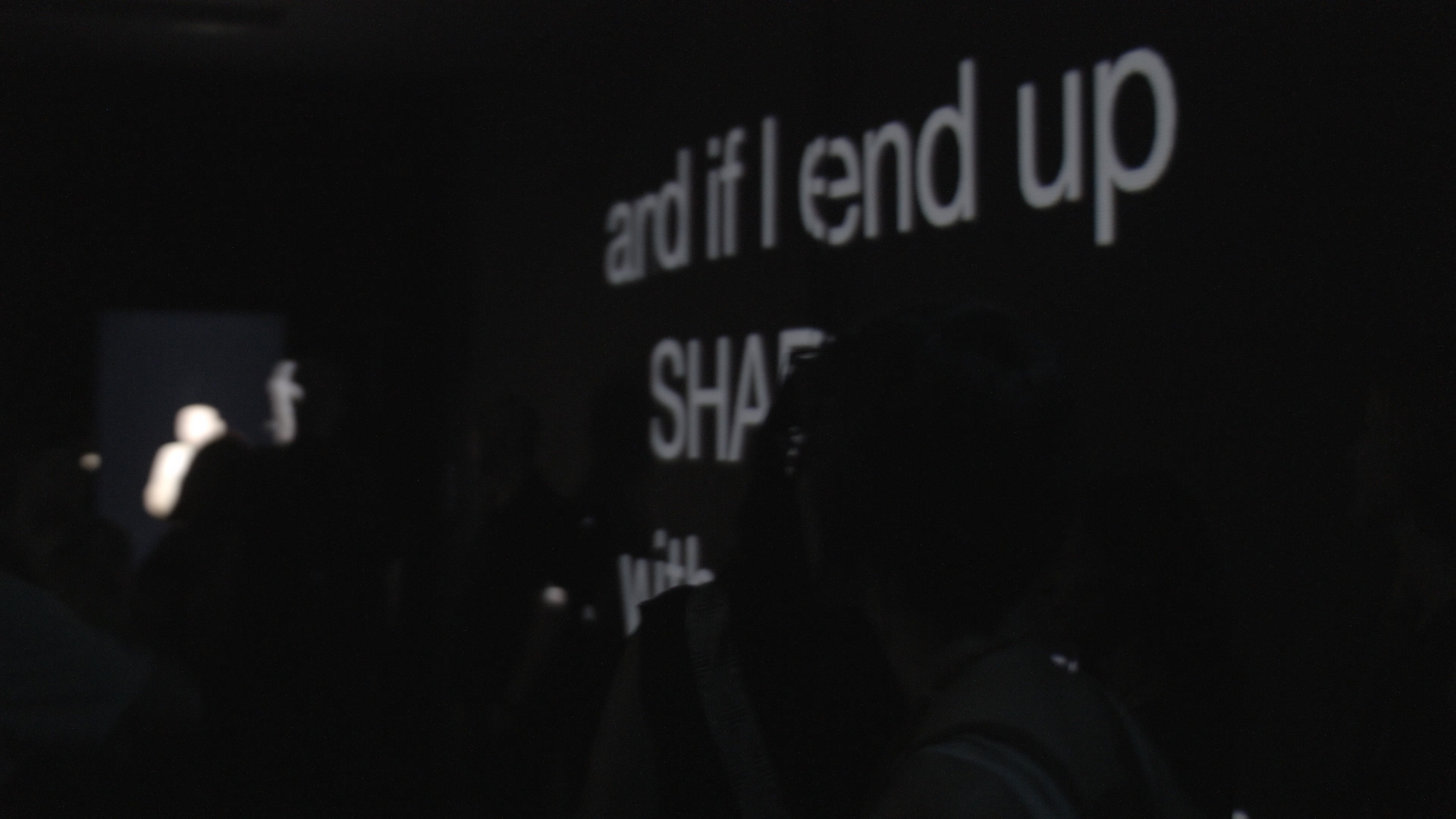
Visitors enter as they would a club: to move, pause, listen, and experience the work at their own pace. Accessibility informed its aesthetics and structure from conception. Sound, moving image, lighting, subtitles and other access elements work together as integral parts of the artistic experience. All spoken, written and printed content was available in Greek and English, with signed content in Greek Sign Language and International Sign.
Starting from lived experience
The Collaborative Working Group (CWG) discussed the interview questions and asked the artist to broaden one focused on challenges, making space for positive experiences, pleasure, desire and imagination alongside barriers. This helped open the research beyond accounts of exclusion, enriching the material that became sound, rhythm and narrative.
The artist interviewed disabled people active in dance, music and club culture.
The Greek CWG included Nikos Voyiatzis, Eva Gkritzali, Thomas Diafas, Andreas Plemmenos, Maria Thrasyvoulidi, Grigoris Stathopoulos, Marilena Koukouli and Christos Papamichael. Its discussions asked how subtitles, sign language, description, vibration and visual representations of sound could create a coherent club-like environment without losing their access functions.
Access as artistic language
Dynamic subtitles in Greek and English. Large-format subtitles turned spoken testimony in Greek and in English into an expressive visual layer. Typography, scale, capitalisation, timing and movement conveyed words, meaning and emotional emphasis, contributing to the rhythm and atmosphere of the installation. Developed collaboratively, these choices balanced artistic expression with efficiency.
Deaf performers performed Greek Sign Language and International Sign. Sign language became a visual performance and an integral visual layer of the artwork. Deaf and hearing interpreters worked with the artist to align linguistic accuracy with the installation’s artistic language, shaping translation, costume, framing, movement, and editing together. Full-body and profile views supported both access and visual expression.
Creative audio description. The team asked whether audio description should be a separate service or part of the artistic experience. The result was an atmospheric audio introduction that combined spatial orientation with sound design drawn from the installation. It gave practical information about navigation, accessibility features, and visual language while inviting visitors into the work’s atmosphere.
Visual sound vocabulary. Porfyris developed four geometric forms to represent sound qualities. They were refined across successive CWG meetings, tested in a dedicated focus group with Deaf and hard-of-hearing participants, and revised in response to their feedback. Participants said the system helped them perceive rhythmic structures and sonic variations that might otherwise have remained inaccessible, and stimulated their imagination.
The final associations between sound qualities and geometric forms were:
| Shape | Sound quality |
|---|---|
| Parallelogram | Deep, subterranean sound and basslines |
| Rhombus | Sparkling or wave-like sound |
| Triangle | Short metallic sound |
| Circle | Piercing percussion sound |
These symbols became an additional artistic language rather than technical diagrams, enriching the installation for Deaf, hard of hearing and hearing visitors alike.
Vibration, sound, light and moving image. These offered complementary ways to experience rhythm and atmosphere. During production, the team refined subtitle projection, colour, lighting, filming and the presentation of sign language. Testing the elements together in the installation space revealed how they worked as a whole.
Audience evidence and learning
Approximately 200 people visited the installation, and 36 completed a voluntary post-visit questionnaire. The questionnaire was an accessible Google Form with open fields that allowed responses in sign language video and audio as well as text. The highest average ratings were for feeling welcomed and included (4.94/5) and accessibility and ease of navigation (4.92/5). Overall satisfaction and interest in attending similar accessible cultural events both scored 4.81/5. Encouragement to think differently about inclusion and equal participation scored 4.75/5, while prior familiarity with inclusive artistic practice averaged 3.39/5. These findings reflect the responses of those who completed the questionnaire and cannot be generalised to all visitors.
Visitors particularly valued the visual representation of sound, sign-language performances and creative audio description as integral parts of the artwork. Their responses highlighted how multisensory accessibility contributed to enjoyment, emotional connection and a sense of belonging. One visitor described experiencing:
“…the rhythm with all my senses.”
Andreas Plemmenos, a member of the CWG, said:
“During the exhibition, I saw Deaf and Hard of Hearing people feeling at ease in the space, because they could see the emotion and the human element within it. I remember vividly how excited they were about the drawings. I felt that, through them, they were able to ‘hear’ the sound more clearly.”
Beyond the artistic experience, the installation encouraged visitors to reconsider accessibility in nightlife and cultural spaces. Asked to imagine their ideal dancefloor, participants described environments characterised by freedom, diversity, mutual respect and equal participation. One envisioned a space:
“…designed so that every body, every way of moving and every way of experiencing music belongs equally.”
A recurring response from Deaf, blind and visually impaired visitors captured the wider aspiration:
“We wish every club was like this.”
The artist and CWG’s post-installation reflection identified the collaborative process itself as one of the project’s greatest achievements. In their assessment, artistic quality and accessibility developed in parallel, producing a work in which all elements were cohesively integrated. Feedback suggests that access features were experienced not as extra services or specialist provision but as integral parts of the artwork, and many visitors said they enhanced their own participation. In this case, DANCEFLOORS shows how Creative Accessibility can lead us to reimagine cultural spaces as environments where artistic innovation and inclusion are developed together.
Nikos Voyiatzis, a member of the Greek CWG, described what made this way of working effective:
“I found the direct communication between members and the transparency of the process particularly supportive and useful. Team members could follow developments even if they missed a meeting. Sharing knowledge and experience was also valuable.”
Thomas Diafas, a member of the Greek CWG, reflected on his mentorship and the space the work created:
“Through my mentorship, I was particularly interested in exploring with the artist how the design of the artwork would affect the audience’s experience when entering the space. I invited him to imagine the visitor as a body that feels and moves, and to develop his artistic process accordingly. “What would you like them to feel?”
It was an interesting and enriching experience, as this collaboration was shaped by professionals who share lived experience of disability and combine it with expertise on the subject.
During the project presentation I was happy enough to see crips and queer crips coming together, communities that are often excluded from the inaccessible Greek club scene. Porfyris created a hospitable and safe space where fun became without doubt political.”
Eva Gkritzali, a member of the Greek CWG, linked this achievement to the experience of the audience and the team:
“My favourite moment was seeing the audience explore the work, interact with it, dance and have fun. Once again, I learned that art and accessibility can go hand in hand and create truly magical results. I feel grateful to have worked with Lykourgos and the whole team. Each person, through their own role and energy, made a meaningful contribution to the final result, and I warmly thank them all.”
The artist reflected on what the process meant for his practice:
“Working with liminal at the P.A.I.R. programme for the implementation of the DANCEFLOORS:DISABLED was a groundbreaking experience not only for the development and the realisation of my idea but also for the creation of my future projects. Despite the fact that I’ve been flirting with accessibility as a part of my practice, this collaboration made me understand deeply the foundations of how to work with accessibility as a fundamental part of the process. From focus groups to individual meetings with the members of the group, from the technical support to practical inputs and from intercollaborative discussions to critical commentary, I had the opportunity to question my practice and rethink my ways of building an accessible landscape that can be observed and experienced by a wider audience.”
What the team would change. Future versions could integrate touch more deeply, improve projection brightness, involve the artist more closely in video editing, and continue developing vibration and haptic systems.
C.A.M. takeaway
Through creative choices, sustained collaboration and testing, multiple access practices can come together to form a shared artistic language, enriching the experience for everyone while remaining open to further development and refinement.
Credits
Artist (concept, realisation)
Lykourgos Porfyris
Collaborative Working Group
Nikos Voyiatzis, Eva Gkritzali, Thomas Diafas, Andreas Plemmenos, Maria Thrasyvoulidi
Audio excerpts feature interviews with
Sabina Ahmed, Iva Srot, Vangelis Mistiloglou
Voiceover
Maria Thrasyvoulidi, Melissa Kotsaki, Lykourgos Porfyris
Project Coordination
Marilena Koukouli, Christos Papamichael
Project Manager
Polina Manolia
Communication
Olympia Antonena
Production
liminal
Accessibility credits
Performance in Greek Sign Language and International Sign
Nafsika Koskori, Andreas Plemmenos, Chara Riga
Sign Language Direction
Andreas Plemmenos
Sign Language Interpretation
Androniki Xanthopoulou
Audio Description
Lykourgos Porfyris
Audio Description Direction and Quality Control
Maria Thrasyvoulidi, Eva Gkritzali
Translation and Subtitling
Lykourgos Porfyris, Grigoris Stathopoulos
Audio Translation Advisory Team
Katerina Mistiloglou, Panos Tsinaris
Graphic design of audio description symbols
Evi Panagiotopoulou
Audio description symbols programming
Stelios Korkotsidis
Sound mastering
Iraklis Vlachakis
Studio
AUX
Missing Frequencies | Cyprus
- Artist: Nafsika Hadjichristou
- Partner: Alternative Brains Rule (ABR)
- Format: Multisensory video installation using moving image, photography, animation, collage, experimental sound, captions, description and haptics
- Place and dates: Lefkosia, Cyprus; 28-30 July 2026
- Creative question: What happens when sound is not only heard, but also felt, seen and imagined?
- Project page: Missing Frequencies
Introduction
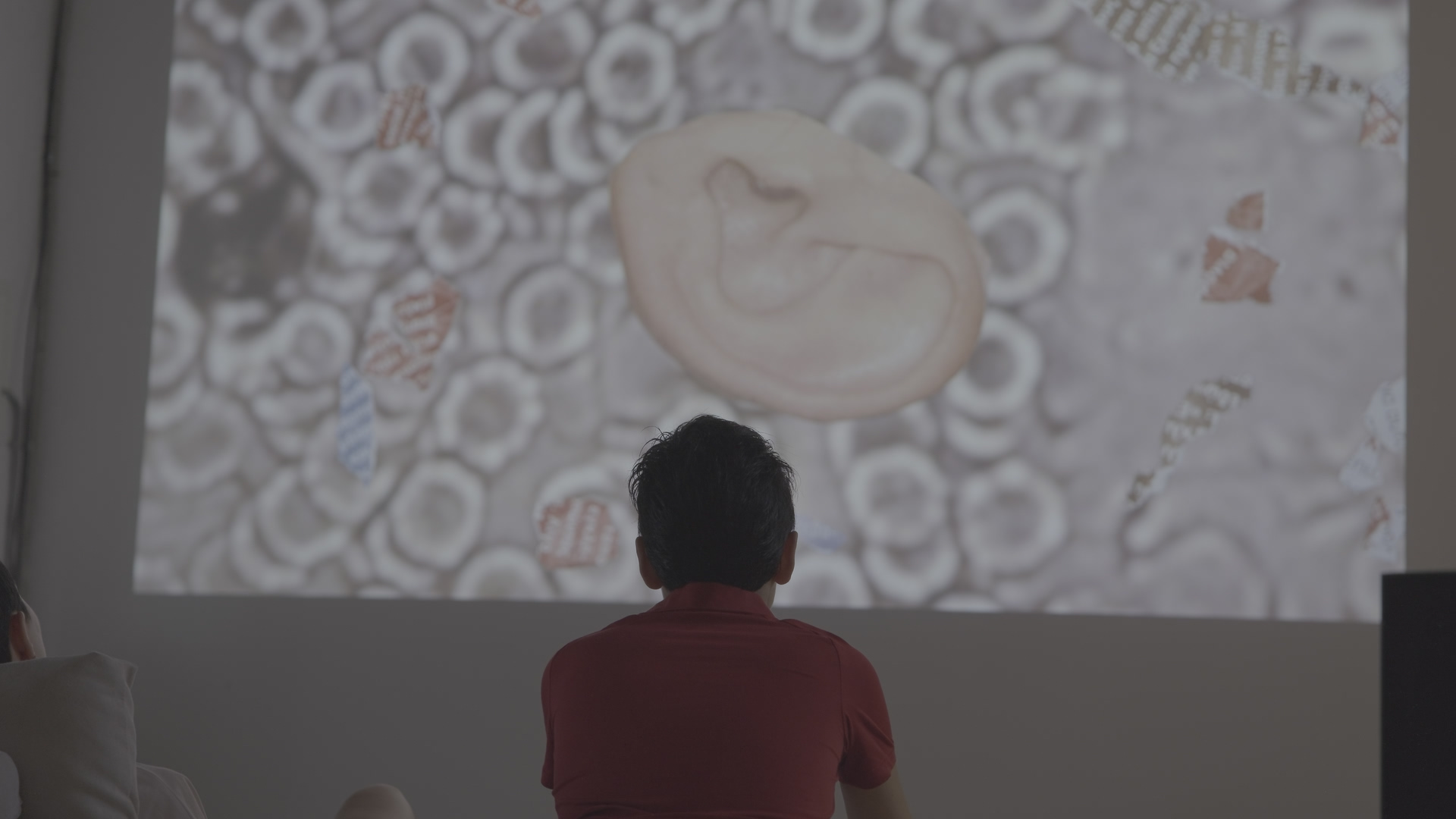
Missing Frequencies is a multisensory video installation by Nafsika Hadjichristou, presented by ABR as part of P.A.I.R. and exhibited in Nicosia from 28-30 July 2026. It combines moving image, photography, animation, collage, experimental sound, captions, audio description and haptic technology to invite audiences into an intimate, bodily experience of partial hearing: sound that is not only heard, but felt, seen and imagined.
Rather than offering a single narrative, the installation moved through images, textures, rhythms, distorted sounds and moments of mishearing, translating between sound, image, text and vibration. Its abstract, open form gave visitors real choice: how long to stay, where to sit, which senses to lean on, and how to combine the elements on offer.
Like DANCEFLOORS:DISABLED, Missing Frequencies treated access as part of the artistic concept from the outset. It was the first time the artist and ABR had built a work around this combination of creative accessibility practices, and the process kept shaping the installation until its final days.
Starting from partial hearing
The installation grew out of the artist’s experience of living with partial hearing loss. The Cyprus CWG (Demetra Nikodemou, Roz, Eve Petrakidou, Marina Ierides, Nina Poulouzasvili, Melina Theodorou, Martha Georgiou and Constantinos Kyprianou) followed the project’s development and shaped both the artwork and the encounter. The process challenged the assumption that experience of one disability creates expertise in all disabilities.
Layered, combinable access
Rather than offering a single fixed way to experience the work, the installation layered multiple accessibility elements that visitors could combine freely:
- Continuous audio description on a loop through two sets of headphones near the sofa and haptic cushions. It added an interpretive layer rather than a purely explanatory track, and could be used independently or alongside the images, captions, sound, and vibration.
- Bilingual captions and labels (Greek and English), offering textual routes through the work.
- Two haptic cushions, developed for the project, translate rhythm, bass, and intensity into vibration felt through the hands, chest, or stomach. Several visitors found the sensation both intense and comforting, a way of engaging with the artist’s intentions through the body rather than through hearing alone.
- Cypriot Sign Language hosts supporting the artist’s opening presentation.
- Flexible seating: a sofa and chairs with and without armrests, at different distances from the main work, with further seating outside. This supported different mobility, height, weight, fatigue, and comfort needs, including people using crutches.
- Step-free circulation throughout the exhibition, and an accessible toilet across the street with a safe route to reach it.
Seating, labelling, contrast, equipment and movement were adjusted throughout installation. Visitors used the elements in unexpected combinations: closing their eyes while using a cushion, listening to the audio description without watching, or deliberately switching between channels.
“It made me leave behind my usual way of experiencing art, to think, question, and encounter the work differently.”
The aim was not to simulate disability for non-disabled visitors, but to interrupt habitual ways of sensing and let each person construct their own encounter with the work.
Audience evidence and learning
The exhibition recorded 135 visitors, including an estimated 20 disabled visitors or people with access requirements. Fourteen people (10.4%) completed the post-visit evaluation, so results are indicative. Mean scores were high for overall satisfaction and meaningfulness (4.86/5), interest in similar events (4.86/5), clear advance information (4.79/5), navigation (4.71/5), and support from access elements (4.71/5). As with DANCEFLOORS:DISABLED, prior familiarity with inclusive artistic practice was comparatively low, while satisfaction, learning and willingness to return were high. Among this small group of respondents, this may suggest the installation reached people with little exposure to this kind of work and prompted real reflection.
Visitors described the haptic elements as a way of stepping into another perspective:
“Touching the cushion and feeling the intensity of the artist’s experience in my chest and hands was very different. It was intense and beautiful because I felt I could step into another person’s shoes and begin to understand what partial hearing might mean.”
Others noted a shift in how they thought about access to art:
“I never really considered how art could be inaccessible to those with disabilities. I just took it for granted. I’m glad this made me more aware and appreciate this initiative to make art more inclusive for others who wouldn’t be able to experience it in the regular way.”
“Making art accessible is a creative process.”
The team concluded that audience agency was central to the work’s success.
What the team would change. Future development could translate more detailed qualities of sound (texture, frequency, spatial movement) through the haptic cushions, increase contrast in printed materials, and explore separate spaces that isolate or emphasise particular senses. These approaches would aim not to simulate disability but to make visitors more aware of how their experience of art changes with the senses they use. Access elements could also be woven more deeply into the artistic language, so they are experienced less as adjacent components and more as part of the whole.
C.A.M. takeaway
Multiple entry points are valuable when each has a clear purpose, and audiences can combine or isolate them. Observing unplanned uses can generate knowledge that a design meeting alone cannot.
Credits
Artist
Nafsika Hadjichristou
Sound Design
Antonis Antoniou
Haptics
Yiannis Souhis
Collaborative Working Group
Demetra Nikodemou, Roz, Eve Petrakidou, Marina Ierides, Nina Poulouzasvili, Melina Theodorou, Martha Georgiou, Constantinos Kyprianou
Video Documentation
Antonis Pouliasis
Photography
Michalis Demetriades
Production
ABR (Alternative Brains Rule)
The Passage | Estonia
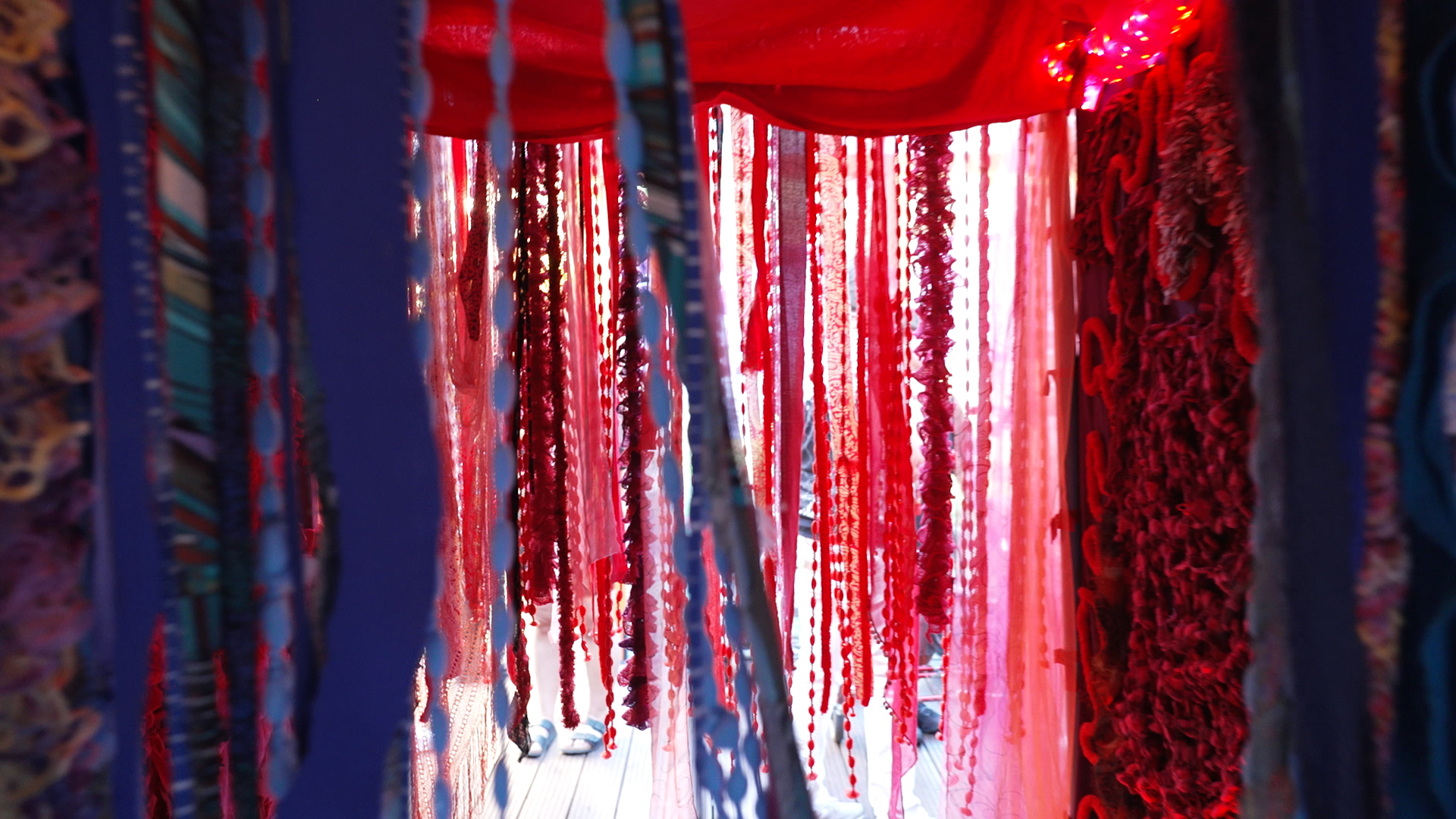
- Artists: Heleri Luuga, Marleen Kuusik and Sara Fontana
- Partner: Estonian Agrenska Foundation, with the Estonian Chamber of People with Disabilities
- Format: Multisensory installation using fabric, handmade objects, colour, photography, collage, sound, light, video and participation
- Place and dates: Paavli Kultuurivabrik, Tallinn; 17 July–31 August 2026
- Creative question: How can a multisensory environment invite people to encounter diversity and reflect on birth, childhood, connection and home?
- Project page: The Passage
Introduction
The Passage is a multisensory installation by the Open P.Arts Collective (Sara Fontana, Marleen Kuusik and Heleri Luuga), created within P.A.I.R. and presented by the Estonian Agrenska Foundation at Paavli Kultuurivabrik in Tallinn from 17 July to 31 August 2026. Visitors moved through three stages (birth, encounter and coexistence) in a sequence of intimate environments exploring childhood, belonging and human connection. Two fabric passageways led through tactile, sensory spaces towards a video installation. Visitors could choose where to begin, how long to stay, which senses to use, and whether to experience the work alone or with others.
A passage with multiple routes
Visitors could touch materials, listen to sound, examine visual details, interact with objects, and add their own words to the work.
The Red Room: The Womb. Behind red curtains, a warm, dimly lit space enveloped in soft fabrics evokes the womb. Different textures invite exploration through touch, and a low, continuous heartbeat plays through a bass speaker, giving the room a quiet, living pulse. Each participant begins primarily alone, with themselves.
The Blue Room: The World’s Intervention. Blue curtains open the experience towards another person. A central fabric partition has openings and pockets holding small objects. Visitors can reach through, exchange things, offer a hand, look at one another, or stay on their own side. There is no obligation to interact: a gesture can be offered, accepted or declined, making the space a place for discovering boundaries, curiosity and consent.
The White Room: The Encounter. Participants meet face to face. A short film brings together images of people, nature, animals, care and birth, alongside people from different places speaking about their names and what “home” means to them. Soft objects and building blocks invite further exploration, and chairs offer a place to sit and pause for as long as needed.
Visitors were also invited to write on a shared canvas who they are and what home means to them. Their words remain, joining the traces left by earlier visitors.
Function, choice and tension
Accessibility was part of the artistic form from the beginning. The Estonian CWG (Mari Tuulik, Daniel Kotsjuba, Mare Kõrtsini and Hendra Raud) brought experience in scenography, mobility, accessible communication and disability, and reviewed stability, dimensions, communication, sensory conditions, neurodivergent participation and ease of use.
Mare Kõrtsini described the value of her scenography expertise in keeping the structure safe without limiting the art:
“It was great to be of help, particularly through my expertise in scenography. Discussing and advising on how to keep the installation strong and stable without hindering the artistic element was very valuable.”
Mobility and rest: Step-free routes ran throughout, and both passageways were checked for mobility-device circulation. An accessible toilet, varied seating, and a quieter area offered further support, including seating near the final video for visitors who could not stand for long.
Choice: Visitors could leave and return, choose their distance from the work, or take optional help with navigation and interaction.
Guided experiences: Some became artistic encounters in themselves. Visitors could close their eyes while artists gave verbal context or guided their hands towards materials, which particularly helped blind visitors and people needing support to navigate, reach, or interact.
Information formats: Estonian and English, with Easy Read, audio-described, and Estonian Sign Language versions. The video had Estonian and English subtitles, sign-language interpretation was provided at the opening, and a sign-language invitation was shared in advance. Mari Tuulik, whose expertise is in accessible communication, noted that the exchange worked in both directions:
“The artists were already very aware of mobility access. My expertise in accessible communication was therefore important, and I also benefited from the process by learning how to align the different tasks more effectively.”
Flexible participation: Visitors could play with puppets and toys, search with flashlights, interact through the fabric wall, choose a new name as they emerged from the passage, or add words to the canvas, setting their own pace and intensity. Hendra Raud, who uses an electric wheelchair, valued that access went beyond the physical:
“I use an electric wheelchair, and many cultural and entertainment venues are not easy to access. At The Passage, there were many different layers to experience. I was glad that several accessibility solutions had been considered, not only physical accessibility.”
A genuine tension. Testing showed that access requirements can conflict. A floor-level resting area could support visitors who wanted to lie down in the womb-like space, but it could also obstruct wheelchair circulation. The team prioritised a clear route in this version and identified a half-width resting area as a possibility for future testing. Creative Accessibility requires negotiation between different needs rather than assuming one solution serves everyone.
Daniel Kotsjuba reflected on what the wider collaboration made possible:
“Cooperation opportunities such as P.A.I.R. open doors for innovation. The selected Estonian team was a mixed, international group. It created bridges and helped people get to know one another.”
Audience evidence and learning
The opening welcomed 60 people, 20 of whom identified as disabled or as having access requirements. A further 60 visits were recorded later, for a total of 120 confirmed visits; because the installation was sometimes open without the team present, total attendance may have been closer to 200. Twelve people completed the accessible evaluation form, so results are indicative.
Respondents gave average ratings of 5.00/5 for feeling welcomed and interest in similar events; 4.75/5 for overall satisfaction, support from access elements and encouragement to think differently about equal participation; and 4.50/5 for information and navigation. Visitor feedback highlighted sensory choice, play, nostalgia, rest and emotional connection. Some visitors stayed for up to an hour.
The handmade quality drew attention to the sewing, gluing, drawing and construction, and visitors often wondered how long the work had taken. In the Blue Room, toys, puppets, flashlights and small objects encouraged play and prompted associations with childhood, memory and home. The final video created a quieter, more contemplative experience, described as meditative and thought-provoking, prompting reflection on identity, belonging and the people or places that feel like home. The range of people and languages in the video created connection without erasing differences.
“The Passage felt like entering a room that listens and enables me to enjoy art through several senses at the same time.”
“Excitement, joy, togetherness.”
Visitors’ contributions to the canvas included:
- “Home is where my family is.”
- “It’s when I’m allowed to feel.”
- “Where I am myself, kept and safe.”
- “Where you are welcome, no matter what.”
What the team would change. Future priorities include more space around the structure, an accessible resting option that preserves circulation, clearer explanation of artistic intention and access before arrival, and further testing of guidance that does not reduce independent exploration.
C.A.M. takeaway
An accessible artwork need not produce the same experience for everyone. It can offer several meaningful ways to enter, navigate, and connect, while making tensions and limitations visible.
Credits
Artists
Sara Fontana, Marleen Kuusik, Heleri Luuga (Open P.Arts Collective)
Accessibility Solutions
Kai Kunder, Ene Oga
Easy to Read
Janek Muru, Kerttu Rakke
Collaborative Working Group
Mari Tuulik, Daniel Kotsjuba, Mare Kõrtsini, Hendra Raud
Video Documentation
Andres Loorand
Photography
Meelis Joost, Mari Tuulik
Production
Estonian Agrenska Foundation, in cooperation with the Estonian Chamber of People with Disabilities
Part 5
What the artworks reveal and how to use it
Eight transferable lessons
Access can be an artistic language
Across all three works, access elements had both practical and artistic roles. Captions carried speech and sound while shaping visual rhythm. Sign language offered linguistic access and contributed gesture, performance, and space. Description communicated visual information and added atmosphere or voice. Vibration conveyed sonic qualities and produced a bodily encounter.
Function remains non-negotiable. Creative treatment must not make an access service less clear, reliable or usable. The opportunity is to develop function and expression together from the beginning.
Lived experience changes the starting point
The strongest ideas emerged from disabled people’s experiences, desires and cultural interests rather than a checklist of presumed deficits. Interviews about nightlife became material for Dancefloors:Disabled. Partial hearing generated the central artistic question of Missing Frequencies. Experiences of mobility, communication, sensory difference and neurodivergence shaped The Passage.
The shift moves from making an existing form available to letting disabled knowledge shape what is created.
Collaboration requires influence
The CWGs affected questions, concepts, materials, spatial arrangements, communication and technical decisions. Lived and specialist expertise complemented each other: users could describe how an element functioned in context; interpreters, describers, and other professionals could assess service quality; artists could develop its relationship to the whole work.
Meaningful collaboration requires involving people early enough, and with sufficient decision-making power, to shape the work rather than evaluate it.
There is no single disabled audience
Experience with one disability does not automatically translate to knowledge of another. Access requirements may support one another, coexist, or conflict. Sound may provide access for one person and overload another. More description may clarify visual action and compete with dialogue. A resting area may support fatigue but restrict circulation.
The practical response is not to promise a perfect solution. Make informed priorities, offer meaningful choice, record tensions and communicate what remains partial.
Multiple entry points create agency
Visitors across the three works could use different combinations of image, sound, captions, sign language, description, vibration, touch, movement and guidance. They could change position, pace, duration, intensity and social interaction.
Choice is not an absence of design. It requires several coherent routes, accurate information and enough space for a person to select how they participate.
Multisensory does not automatically mean accessible
Additional layers may expand meaning or create competition and overload. Each element needs a defined function, intended users, relationship to the artistic concept, and method of testing. The strongest sensory elements in P.A.I.R. carried meaning: visual forms communicated sound qualities and interpretation, haptic cushions translated rhythm and intensity; tactile environments expressed memory, intimacy and belonging.
The goal is not the maximum number of formats. It is a meaningful relationship between form, function and audience.
Prototyping and observation reveal what plans cannot
Caption positions, contrast, lighting, seating, physical dimensions, circulation, equipment and description had to be experienced together. Testing also revealed uses the teams had not predicted. Visitors isolated senses, combined tools, stayed longer than expected and explored different parts of the installations in unexpected ways.
Prototype in a cycle: make → test → observe and listen → revise → retest. An unsuccessful prototype is useful when the team can still change direction.
Access includes the conditions around the artwork
An integrated caption or tactile object has limited value if a person cannot find accurate information, enter the venue, rest, use a toilet or ask for help. Creative Accessibility covers the artwork, venue, communication and social environment as one encounter.
Evaluation is part of that encounter. Use accessible feedback methods and report the limits of the evidence. Scores can show patterns; observation, conversation and disagreement often reveal what to change.
Part 6
Creative Accessibility toolbox
The tools below convert C.A.M. into workshop and project activities. They are not a fixed sequence or compliance test. Select the tool that matches the decision in front of the team and return to it when evidence changes.
Scroll the table sideways to see every column.
| If you need to… | Use | Main result |
|---|---|---|
| Identify collaborators, relationships and participation gaps | Tool 1: Stakeholder mapping | Map of stakeholders, connections and gaps |
| Connect access to artistic intention | Tool 2: Access and artistic intent canvas | Artistic and access intention with research priorities |
| Identify missing expertise and clarify decision-making influence | Tool 3: Knowledge and influence map | Recruitment and participation plan |
| Design and test meaningful ways into the work | Tool 4: Multisensory entry point map and testing guide | Entry-point map with test evidence and design decisions |
| Review the complete visitor experience | Tool 5: Audience journey walkthrough | Prioritised actions with owners, deadlines and backups |
| Tell audiences what access is available and what to expect | Tool 6: Access statement | Clear audience-facing access information |
| Turn experience and feedback into improvements | Tool 7: Shared experience and learning review | Keep / Change / Test next / Communicate honestly record |
Tool 1 | Stakeholder mapping
Map the artists, audiences, community groups, disability organisations, access specialists, cultural institutions and funders connected to the project. Use the map to identify collaborators, gaps in participation, overlooked local resources, and power imbalances. A stakeholder map isn’t just an organisational nicety; it’s a diagnostic tool. Done honestly, it usually reveals:
- Who’s missing: e.g. no disability-led organisations on the map, or only one “token” community contact
- Where power sits: funders and institutions often cluster with more connections than grassroots groups, which can flag an imbalance worth correcting before the project starts.
- Untapped local assets: disabled artists’ collectives, access consultants, deaf clubs, mental health and care organisations, special schools/colleges-groups often overlooked in favour of larger, more visible institutions
How to build it
- Start with a blank centre - the project itself.
- Add every stakeholder as a node, grouped by type.
- Draw the actual connections that exist today - not aspirational ones. Weak or single-person relationships should look visibly different (e.g., dotted lines) from strong, multi-contact ones.
- Mark the gaps explicitly - an empty category, or a category with only “possible” contacts, is often the most useful output of the whole exercise.
- Revisit it periodically - stakeholder maps go stale fast; treat it as a living document, not a one-off output.
Keep these distinctions visible
- Disabled-led and disability-focused organisations: organisations run by disabled people may have different priorities from those working on their behalf.
- Access specialists and advocacy organisations: distinguish technical access expertise from representation and advocacy.
- Formal organisations and informal networks: include local collectives, carers’ groups and online communities (carers’ groups, online communities, local Facebook/WhatsApp groups) alongside institutions.
Tool 2 | Access and artistic intent canvas
Purpose: Connect accessibility to the central artistic question before form and production decisions harden.
When to use: At project initiation, concept development, or the start of a major redesign.
Who should take part: Core artists, producers, disabled contributors, relevant access professionals, and someone able to make budget or scheduling decisions.
Work through five fields
Artistic intention
- What question, feeling, relationship or experience drives the work?
- What should remain alive even if the form changes?
Current language
- Which senses, languages, movements, technologies, or interactions carry meaning?
- What assumptions does the work make about seeing, hearing, moving, reading, processing, endurance, or communication?
People and context
- Who is already involved?
- Who may encounter a barrier or be absent from the creative process?
- Whose lived, local or technical expertise is needed?
Creative access possibilities
- How could access change form, dramaturgy, pacing, space, or participation?
- Which ideas need research rather than immediate selection?
Practical priorities
- What is realistic within the current time, skills, and resources?
- Which costs and responsibilities must be added now?
Complete the statement
This work explores __________. Its meaning is currently carried mainly through __________. We want to develop meaningful access with/for __________ by exploring __________. We need further knowledge or support relating to __________. The first decision this work will influence is __________.
Output: A one-paragraph artistic-and-access intention, three research priorities and a named owner for the next action.
Facilitation check
If the group begins listing services immediately, return to the work’s meaning and assumptions. The tool frames the problem before selecting solutions.
Tool 3 | Knowledge and influence map
Purpose: Identify whose knowledge is present, who is missing, and how each participant can affect the project.
When to use: Before recruitment, forming a CWG, commissioning access work or beginning consultation.
- Lived experience
- Artistic practice
- Access-service expertise
- Technical production
- Local cultural context
- Audience / community knowledge
- Organisational authority
Power check
- Are disabled people participating as artists, decision-makers and paid experts, or only as consultees and testers?
- Which decisions are already fixed? Are invitations honest about this?
- Who can approve money, time and design changes?
- Can participants disagree safely with the lead artist or organisation?
- Is one person being expected to represent an entire group?
- How will the team report back on what changed?
Output: A recruitment and participation plan specifying roles, authority, fees, access, credit, meeting rhythm and feedback loops.
Facilitation check
“Representation” without influence is not co-creation. Add a decision pathway beside every invited role.
Tool 4 | Multisensory entry point map and testing guide
Use one row for each entry point or access element.
Scroll the table sideways to see every column.
| Essential meaning or experience | Current channel and barrier | Proposed entry point and intended users | Function and artistic contribution | Quality and visitor control | What needs testing? |
|---|---|---|---|---|---|
| What must visitors encounter, understand or do? | Sight, sound, speech, movement, text or space: what might prevent access? | Caption, description, sign language, touch, vibration, Easy Read, guidance or another route: who might benefit? | What must it communicate or enable? How does it contribute to form or meaning? | What must remain accurate, clear, safe and reliable? What can visitors adjust or decline? Note equipment, staff or booking requirements. | What is uncertain? What evidence would demonstrate success or failure, and who should test it? |
Test and decide
Choose one important uncertainty from the table.
- Test: State the assumption, what you need to learn, and success and stop criteria.
- Setup: Make the simplest useful prototype. Record testing conditions, testers, relevant expertise, and access required for the session.
- Evidence: Record what participants did and what they said. Note what worked and what caused barriers, confusion, or discomfort.
- Two checks: Record separately whether it worked as access and as art. Success in one does not establish success in the other.
- Decision: Retain/revise / replace / discontinue. Record changes, owner and retest date, then update the table.
Prototypes can be simple: a description read against a scene, taped caption sightlines, cardboard tactile forms, phone-camera sign-language framing, a paper interface, sound-and-vibration samples or a route walkthrough.
Keep these questions in view
- What disappears when the dominant sensory channel(s) is unavailable?
- Does the alternative carry essential meaning and add an artistically coherent perspective?
- Do channels reinforce one another or compete?
- Can visitors adjust pace, intensity, position or duration, and decline intense elements?
- Are practical requirements clear?
Output: One working record connecting access ideas, artistic intentions, test evidence and decisions.
Facilitation
Do not assign one sense to one disability category. Include and pay people who use the relevant access service, involve appropriate specialists, and apply relevant professional standards. Creative-team preference alone is insufficient evidence. Test in realistic conditions and retest after changes.
Tool 5 | Audience journey walkthrough
Purpose: Review access to the complete cultural encounter, not only the artwork.
When to use: During planning and again at the venue with final systems, information, and staffing.
Walk the route
Use the journey points below as starting rows. Add extra rows where you identify more than one issue.
Scroll the table sideways to see every column.
| Journey point | Visitor task or need | Barrier / failure risk | Evidence | Action | Owner | Deadline | Backup |
|---|---|---|---|---|---|---|---|
| 1. Discovering the event | |||||||
| 2. Understanding content and access information | |||||||
| 3. Booking or registering | |||||||
| 4. Travelling and finding the entrance | |||||||
| 5. Entering and orienting | |||||||
| 6. Collecting equipment or assistance | |||||||
| 7. Moving, sitting, resting or regulating | |||||||
| 8. Engaging and participating | |||||||
| 9. Using toilets, cafés and other facilities | |||||||
| 10. Responding to an emergency | |||||||
| 11. Giving feedback, leaving and following up |
Questions at each point
- Can the person act independently if they choose?
- Is assistance available without being imposed?
- Can the person pause, leave and return?
- Are routes, equipment and facilities available whenever the event is open?
- What happens if the lift, device, internet connection or staff member is unavailable?
- Does the advertised accessibility match the actual experience?
Output: A prioritised action list with ownership, deadline and contingency for each issue.
Facilitation check
Do the second walkthrough under realistic noise, light, crowd and timing conditions. A daytime inspection of an empty venue is not enough for a busy evening event.
Tool 6 | Access statement
Purpose: Give audiences specific information so they can make informed choices and prepare.
When to use: After testing and before public communication. Update it whenever delivery changes.
Template
- This experience includes: __________
- Available during: all sessions / selected dates or sections: __________
- Designed primarily to support: __________
- Coverage: full work / selected sections / introductory material only
- How to use it: __________
- Advance booking or equipment required: __________
- Venue and route information: __________
- Seating, rest and quiet-space options: __________
- Sensory and environmental conditions: __________
- Areas that remain partial, experimental or unavailable: __________
- Backup if a service or device fails: __________
- Contact for access questions or requests: __________
Writing principles
- Name the format rather than using vague labels such as “accessible performance.”
- Explain when, where and how it works.
- Distinguish a full service from a sample, introduction or selected session.
- Describe intense light, sound, touch, smell, movement or crowd conditions factually.
- Avoid “fully accessible.” No single statement can guarantee access for every person.
- Invite contact without making individual disclosure the only route to basic information.
- Provide the statement in accessible formats, such as sign language video, an audio version and plain language text.
Output: A concise, audience-facing description checked by the artistic, access, production and communications teams.
Facilitation check
Compare every sentence with the final audience journey. Remove promises that the team cannot reliably deliver.
Tool 7 | Shared experience and learning review
Purpose: Bring together audience experience, participant feedback and team reflection to improve the current work and inform future practice.
When to use: After a prototype, workshop, project phase, performance, exhibition or event and early enough for the learning to influence what happens next.
Who contributes: Audiences, artists, access users, disabled collaborators, accessibility practitioners, facilitators, front-of-house staff, technicians and project partners. People do not need to contribute in the same format or at the same time.
Step 1 | Gather audience and participant experience
Offer different ways for people to respond based on their access needs, communication preferences, and confidence. These may include:
- short accessible questionnaires;
- informal or facilitated conversations;
- voice notes or video responses;
- drawings, collage or comment cards;
- participatory feedback walls;
- observation of how people used and moved through the work;
- reports from interpreters, audio describers, access workers or front-of-house staff.
Allow people to respond during or after the event, anonymously or with attribution. Obtain consent before sharing identifiable comments, images or stories.
Questions for audiences and participants
- What helped you participate?
- Was anything difficult, unclear, tiring or uncomfortable?
- Which access elements did you use?
- Did any access element change how you experienced the artwork?
- What would you keep, change or explore further?
- Was there something you needed that was not available?
Use clear language and ask only the questions that are relevant to the experience.
Step 2 | Reflect as a creative and production team
The team should review its own experience separately before interpreting audience feedback.
Discuss:
- What worked as planned?
- What changed during delivery?
- Which access elements retained their essential function?
- What barriers, tensions or unexpected uses did we observe?
- How did accessibility influence artistic decisions and audience engagement?
- What practical constraints affected the result?
- Which perspectives or audience groups may be missing from the evidence?
Include artists, access practitioners, facilitators, technicians and audience-facing staff, as each may have noticed different aspects of the experience.
Step 3 | Bring the evidence together
Compare audience accounts, observations, access-service reports and team reflections.
Look for:
- recurring patterns;
- contrasting experiences;
- unexpected uses of access features;
- differences between artistic intention and audience experience;
- barriers affecting only a small number of people;
- questions that require further testing.
Do not reduce disagreement to an average score or force consensus. One person’s experience may reveal a serious barrier even when most responses are positive.
State clearly who contributed, which formats were offered and whose experiences may still be missing. Describe small or self-selecting samples honestly rather than treating them as representative of every audience.
Step 4 | Turn learning into action
Record the outcome under four headings:
Scroll the table sideways to see every column.
| Keep | Change | Test next | Communicate honestly |
|---|---|---|---|
| What worked and should continue? | What should be revised, removed or corrected? | What requires another prototype, conversation or trial? | What strength, limitation or unresolved issue should audiences and partners know about? |
For every agreed action, identify:
- who is responsible;
- what will happen;
- when it will be reviewed;
- who should be involved in the next decision.
Step 5 | Close the feedback loop
Share a short and accessible summary with participants and audiences where possible.
Explain:
- what was learned;
- what will change;
- what will be tested next;
- what cannot currently be changed and why.
Feedback becomes meaningful when people can see how their contribution influenced a decision. A brief learning record that guides action is more useful than a long report that is never revisited.
Output
A shared learning record that combines audience experience, participant knowledge and team reflection, organised under:
Keep / Change / Test next / Communicate honestly
The record should include actions, responsible people and review dates.
Facilitation check
Feedback should be safe, voluntary and accessible. Participants must be able to criticise the work or process without risking future involvement. Record disagreement and minority experiences rather than presenting consensus where none exists.
Quick project check
Before describing a work as creatively accessible, confirm that:
- Disabled and D/deaf people have influenced the work, not only reviewed it.
- Participants know their role, authority and route for disagreement.
- Lived, artistic and specialist expertise has been paid and credited.
- Access priorities connect to artistic intention and intended audiences.
- Each access element has a defined function, artistic role and quality criteria.
- Creative integration has not compromised accuracy, clarity, safety or usability.
- Prototypes have been tested with intended users under realistic conditions.
- Findings have produced documented changes and retesting where needed.
- The complete audience and participant journey has been checked.
- People have meaningful choice over pace, position, intensity, format and support.
- Access tensions and unresolved barriers have been recorded.
- Public information describes what is available, how it works and where it is partial.
- A backup exists for essential staff, equipment or technology.
- Feedback methods are accessible and the limits of evaluation evidence are stated.
- The team has named what it will keep, change and test next.
The checklist is a prompt for inquiry, not a pass-or-fail score. The aim is to support better decisions and continued learning.
References and further practice
Books and articles
- Fotiadi, E. (ed.) (2025) Exhibiting for Multiple Senses: Art and Curating for Sensory-Diverse Bodies. Amsterdam: Valiz.
- Kafer, A. (2013) Feminist, Queer, Crip. Bloomington: Indiana University Press.
- Lawson, A. and Beckett, A. E. (2021) ‘The social and human rights models of disability: towards a complementarity thesis’, The International Journal of Human Rights, 25(2), pp. 348–379. doi:10.1080/13642987.2020.1783533
- Shew, A. (2023) Against Technoableism: Rethinking Who Needs Improvement. New York: W. W. Norton & Company.
- Stuart Fisher, A. and Thompson, J. (eds.) (2020) Performing Care: New Perspectives on Socially Engaged Performance. Manchester: Manchester University Press. doi:10.7765/9781526146816
- Swain, J. and French, S. (2000) ‘Towards an Affirmation Model of Disability’, Disability & Society, 15(4), pp. 569–582. doi:10.1080/09687590050058189
Rights instruments and primary sources
- Union of the Physically Impaired Against Segregation (UPIAS) (1976) Fundamental Principles of Disability. London: UPIAS.
- United Nations (1948) Universal Declaration of Human Rights. Article 27.
- United Nations (2006) Convention on the Rights of Persons with Disabilities. Article 30.
Online resources and further practice
- Access Toolkit for Art Workers. Available at: https://accesstoolkit.art/
- Disability Arts Online (no date) Access riders. Available at: https://disabilityarts.online/resources/guides-and-toolkits/access-riders/
- DuvTeatern (no date) TIKSI project: creative accessibility. Available at: https://duvteatern.fi/eng/tiksi/
- Graeae Theatre Company (no date) Aesthetics of Access. Available at: https://graeae.org/project/aesthetics-of-access/
- INCLUDE+ (no date) INCLUDE+ Principles. University of Leeds. Available at: https://includeplus.org/include-principles/
- National Disability Authority, Centre for Excellence in Universal Design (no date) The 7 Principles. https://universaldesign.ie/about-universal-design/the-7-principles
- Un-Label (no date) Aesthetics of access in artistic production. Available at: un-label.eu
- W3C (2023) Web Content Accessibility Guidelines (WCAG) 2.2. https://www.w3.org/WAI/standards-guidelines/wcag/
Project information
Project
P.A.I.R. | Paving Accessible Inclusive Realities. A Creative Europe project led by liminal (Greece), with Alternative Brains Rule (Cyprus) and the Estonian Agrenska Foundation (Estonia). Project website: pair.liminal.eu. Accessibility contact: info@liminal.eu.
Suggested citation: Accessibility Is the Aesthetic: The Creative Accessibility Methodology Manual. P.A.I.R. Project, 2026.
Licensed under CC BY-NC 4.0.
Funding
Co-funded by the European Union. The project is implemented with financial support and under the auspices of the Greek Ministry of Culture.
Views and opinions expressed are those of the authors only and do not necessarily reflect those of the European Union or the European Education and Culture Executive Agency (EACEA). Neither the European Union nor EACEA can be held responsible.